Why You Stop Wanting Frozen Treats the Week It Turns Cold
Quick Answer: Cold food loses appeal in cool weather for three reasons: eating cold food costs you core temperature at a moment when your body is defending it, cold suppresses flavour perception so a frozen treat tastes less of what it is meant to taste of, and the association with cooling down disappears once you are no longer hot. The fixes are practical rather than psychological: serve it less cold (tempered for 10-15 minutes), increase the flavour intensity to compensate for cold-suppressed perception, and pair it with something warm, which is why affogato and hot-fudge formats survive the season.
The freezer still has three tubs in it. Two weeks ago they were disappearing steadily. Now nobody wants any of it, and the thought of a cold dessert on a cool evening is faintly unappealing.
That is not a whim. Cold food genuinely works differently when you are not hot, and both the physiology and the flavour chemistry change.
Some of it is unfixable and some of it is very fixable.

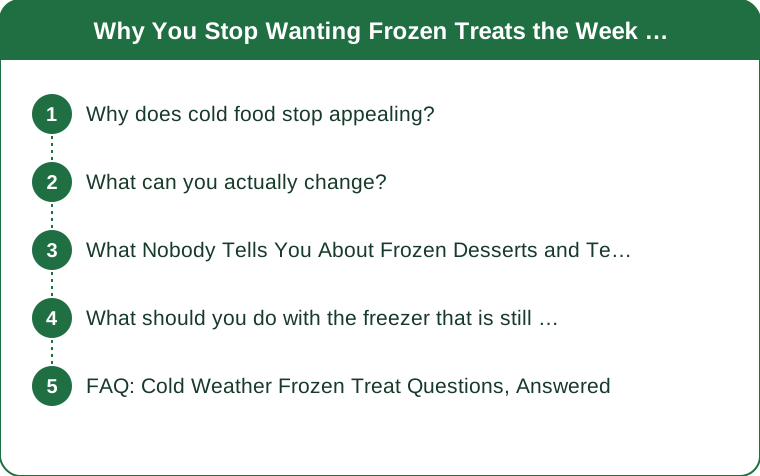
Why does cold food stop appealing?
Three separate mechanisms, and they stack.
Thermoregulation. Eating something frozen requires your body to warm it, which costs energy and briefly lowers core temperature. In hot weather that is the entire appeal - it is a genuine cooling mechanism. In cool weather your body is already working to maintain temperature, so a cold food is working against what your physiology is currently doing. The appeal was never really about the flavour; it was about the temperature.
Flavour perception drops with temperature. This is the largest and least appreciated factor. Taste receptors are less responsive at low temperatures, and - more importantly - volatile aroma compounds do not volatilise as readily when cold. Since most of what we experience as flavour comes through the nose rather than the tongue, a very cold food delivers far less aroma to the olfactory receptors.
This is why ice cream mix always tastes noticeably sweeter and more intensely flavoured before freezing than the finished product does. The recipe is not wrong - the cold is suppressing perception.
Sweetness is affected most of all. Sweet perception drops significantly with temperature, which is why commercial frozen desserts are formulated much sweeter than they taste.
And the context disappears. A large part of frozen dessert appeal is situational - after being outside in the heat, at the end of a hot day, at a beach. Remove the heat and the situational trigger goes with it. Appetite is far more context-driven than people acknowledge.
What can you actually change?
Temperature at serving, flavour intensity, and format.
Temper it before serving. Take it out of the freezer 10-15 minutes before eating. This is the single most effective change - a slightly warmer frozen dessert releases far more aroma, tastes considerably more of what it is supposed to, and is less of a thermal shock. It also scoops properly, which is a separate benefit.
Domestic freezers run at around -18°C, which is colder than commercial serving temperature for ice cream. Most homemade frozen desserts are being eaten too cold to taste properly, and that is true year-round.
Increase the flavour intensity. If you are making things now, push the flavours harder than you would in July. More vanilla, more coffee, more spice, more salt. Salt in particular does a lot of work in frozen desserts and is routinely under-used - it amplifies the flavours that cold is suppressing.
Shift toward warm-spice flavour profiles. Cinnamon, ginger, cardamom, nutmeg. These read as seasonally appropriate and, because aromatic spices are volatile, they carry better through the cold than delicate fruit flavours do.
Serve smaller portions. A small portion of something intensely flavoured is more satisfying in cool weather than a large portion of something mild.
And change the format so it is not purely cold. This is where the real solution is.
- Affogato - a scoop with hot espresso poured over. The contrast is the whole point and it works precisely because half of it is hot.
- Frozen dessert with something warm - a warm crumble, a hot brownie, warmed fruit compote.
- A hot sauce - hot fudge, warm caramel, warm spiced syrup.
- Frozen dessert in a warm drink - a scoop in hot chocolate.
The temperature contrast keeps it interesting while removing the thermal cost, which is exactly the combination that stops working when the dessert is uniformly cold.

What Nobody Tells You About Frozen Desserts and Temperature
Your freezer is too cold for serving, always. Commercial ice cream is served around -12 to -14°C; a home freezer runs at -18°C. That difference is enough to noticeably suppress flavour and to make it hard to scoop. Ten minutes on the counter is doing real work.
Homemade always tastes less sweet than the base did, and that is expected. Sweet perception drops with temperature, so a mix that tasted right at room temperature will taste under-sweet frozen. Commercial recipes account for this by being formulated much sweeter than they seem. If your homemade version tastes flat, the base was probably not sweet or salty enough, not over-frozen.
Fat carries flavour and softens texture. Lower-fat frozen desserts freeze harder, taste less intense, and suffer more in cold weather because there is less fat to carry the aroma compounds. This is why a low-fat frozen yoghurt is a harder sell in October than a full-fat ice cream.
Alcohol and sugar both lower the freezing point, producing a softer texture at the same temperature. A tablespoon of a spirit in a homemade base makes it scoopable straight from the freezer - which also means it is served slightly warmer and tastes more of itself.
Protein-based frozen desserts get harder and icier in cold weather - or rather, their existing texture problems become more noticeable because you are less motivated to overlook them. Tempering matters more for these than for anything else.
And the appetite shift is real and not a failure of will. Craving warm, calorie-dense food as temperatures drop is a well-documented seasonal pattern. Working with it - warm formats, spiced flavours, contrast desserts - is more productive than trying to want the same thing you wanted in August.
What should you do with the freezer that is still full?
Use it in formats that suit the season rather than waiting for it to be summer again.
Serve it with something hot. The simplest conversion. A scoop on a warm crumble, alongside a hot brownie, over warm poached fruit. The frozen element becomes the contrast rather than the whole dessert, which is a completely different experience.
Blend it into a milkshake with warm spices. A thick shake with cinnamon and nutmeg reads as autumnal and uses up a tub efficiently.
Affogato, which is the best of them. A scoop in a cup, hot espresso over the top. It takes thirty seconds, it uses what you have, and the hot-cold contrast is genuinely one of the better desserts there is.
Fold it into a baked dessert. Melted and used as part of a custard base, or as the liquid in a bread and butter pudding. Ice cream is essentially a sweetened custard, so it works well in that role.
Temper everything before serving, whatever you do. Ten to fifteen minutes.
And if you are still making frozen desserts through autumn, shift the flavour profile toward warm spices, coffee, caramel, nuts and chocolate, and push the intensity and salt higher than you would in summer. These carry through the cold far better than delicate fruit flavours, which is why the summer berry sorbet that was perfect in July tastes thin in October.
One last practical point: frozen desserts do not keep indefinitely. Ice crystals grow over time, particularly with temperature fluctuation from opening the freezer, and texture degrades. A tub that has been in there since July is meaningfully worse than it was, and that may be part of why nobody wants it.
FAQ: Cold Weather Frozen Treat Questions, Answered
Why does my homemade ice cream taste less sweet than the base did?
Sweetness perception drops significantly at low temperatures, and aroma compounds volatilise less readily when cold, so you get less of both taste and smell. The base should taste slightly too sweet and slightly too strongly flavoured at room temperature for the frozen version to taste right. Adding a pinch of salt also helps considerably, since salt amplifies perceived sweetness.
How long should I let it sit before serving?
Ten to fifteen minutes for most home-frozen desserts, longer for anything low-fat or protein-based, which freeze harder. You are aiming for a texture that scoops cleanly with a little resistance. This is worth doing year-round, not only in autumn - most homemade frozen desserts are eaten too cold to taste properly.
Do frozen desserts go off in the freezer?
They do not become unsafe in any normal timeframe, but the texture degrades steadily. Ice crystals grow with each temperature fluctuation, which is why a tub that has been opened repeatedly gets icy. Pressing a layer of parchment directly onto the surface before putting the lid back on slows it considerably, and anything more than a couple of months old is usually worth using in a blended or baked format rather than served straight.
TL;DR:
- Three things drop the appeal: cold food costs core temperature when you are defending it, cold suppresses flavour (especially sweetness and aroma), and the hot-day context disappears.
- Your freezer is colder than serving temperature. Ten to fifteen minutes of tempering is the single most effective fix, and it applies year-round.
- Push flavour and salt harder than you would in summer to compensate for cold-suppressed perception.
- Warm spices, coffee, caramel and chocolate carry through the cold far better than delicate fruit.
- Pair with something hot - affogato, a warm crumble, hot fudge. The contrast survives the season; uniform cold does not.
The tub that has been in there since July is genuinely worse than it was. Blend it or bake with it rather than waiting for someone to want a bowl.
Keep Reading
This article is for general informational purposes only and is not medical advice. Always consult a qualified health professional for guidance specific to you.