Why Shop-Bought Frozen Desserts Scoop and Yours Comes Out Like Concrete
Quick Answer: Commercial frozen desserts contain a large volume of whipped-in air called overrun - often 25 to 50 percent of the finished tub - plus stabilisers that keep ice crystals small. Air makes a frozen mixture soft and scoopable; a dense homemade base with no air freezes into a solid block. At home you can imitate this by churning properly, folding in whipped cream, using a little alcohol or invert sugar to lower the freezing point, and storing it in a shallow container rather than a deep one.
You make something genuinely delicious, freeze it overnight, and then need a knife and a real sense of grievance to get it out of the tub.
The missing ingredient is not an ingredient.

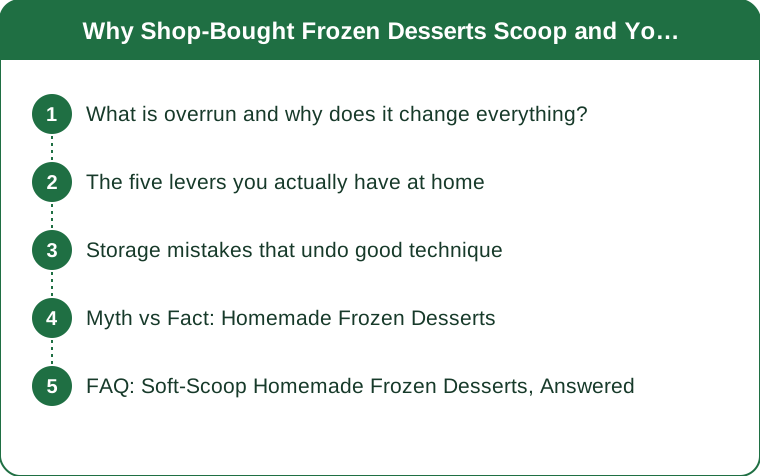
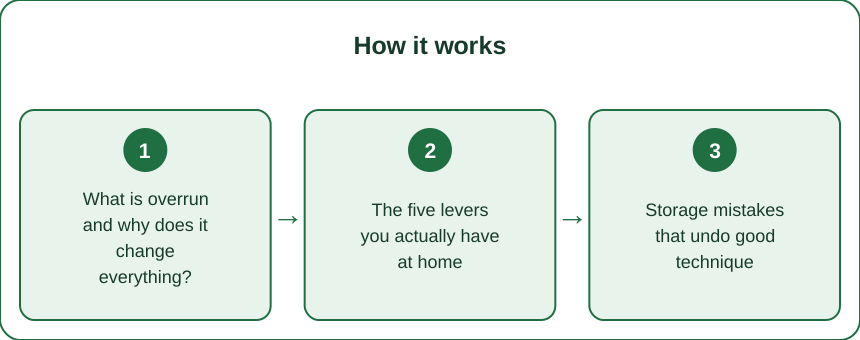
What is overrun and why does it change everything?
Overrun is the air whipped into a frozen dessert during churning, expressed as a percentage increase in volume. A base that doubles in volume has 100 percent overrun.
Air is a poor conductor of heat and it physically interrupts the ice structure. Millions of tiny bubbles stop ice crystals joining into a continuous solid mass, which is exactly what makes a scoop possible.
Commercial products vary enormously. Economy products can approach the legal maximum overrun, while premium ones sit much lower - which is why premium ice cream is denser, richer, and genuinely harder straight from a home freezer.
A no-churn or blender-based homemade base often has almost no air in it at all, so it freezes as close to a solid block as a sweetened dairy mixture can get.
This is also why homemade tastes more intense. Less air means more flavour per spoonful, so the trade you are making is real - you are giving up scoopability for concentration.
Home freezers make it worse independently. Domestic freezers run considerably colder than the serving temperature of a commercial display cabinet, so even a well-made dessert will be firmer at home than the same product in a shop.
The five levers you actually have at home
Churn properly and churn cold. A pre-frozen bowl that is genuinely at temperature, and a base chilled overnight before it goes in, is the difference between incorporating air and just stirring cold custard.
Fold in whipped cream after churning, or use it as the base. This is how no-churn recipes work at all - the air comes from the whisk rather than from the machine. Soft peaks, folded gently, add substantial volume.
Lower the freezing point slightly. A tablespoon or two of vodka, rum, or another spirit per litre of base depresses the freezing point enough to keep it softer without being detectable. Too much and it will not set at all.
Swap some sugar for an invert sugar. Replacing roughly a quarter of the sugar with glucose syrup, golden syrup, or honey lowers the freezing point and produces a noticeably softer set, because invert sugars are more effective at this per gram than table sugar.
Add a stabiliser. A small amount of cornflour cooked into the base, or a pinch of xanthan gum, binds free water so it cannot form large crystals. This is the least glamorous and most effective single change.
Fat helps too, within limits. A higher-fat base resists hard freezing better than a lean one, which is why low-fat homemade frozen yogurt is reliably the iciest thing in the freezer.

Storage mistakes that undo good technique
Deep containers freeze from the outside in and stay rock-hard in the middle. A shallow, wide container freezes faster and more evenly, which produces smaller crystals throughout.
Freeze it fast. The faster a mixture passes through the crystal-forming temperature range, the smaller the crystals. A base spread thin in a pre-chilled container is genuinely better than the same base in a deep tub.
Press cling film directly onto the surface. The air gap above the dessert is where surface ice crystals and freezer burn form, and a direct contact layer prevents both.
Store it at the back, not in the door. Door temperature swings every time the freezer opens, and repeated partial thaw and refreeze is what turns a smooth dessert grainy over a week.
Do not refreeze a melted batch and expect it to recover. Melting and refreezing produces very large crystals, and no amount of stirring will undo that texture.
And temper before serving. Ten to fifteen minutes in the fridge - not on the counter - brings a homemade tub to a scoopable temperature evenly, without a soft rim and a frozen core.
Myth vs Fact: Homemade Frozen Desserts
Myth: More sugar makes it softer. Fact: sugar does lower the freezing point, but adding enough to fix the texture makes it inedibly sweet. Swapping some sugar for glucose or honey achieves more per gram.
Myth: You need an expensive machine. Fact: a folded whipped cream base with a stabiliser and a shallow container gets most of the way there. Machine churning helps, but technique and storage matter more than the machine’s price.
Myth: Alcohol is a cheat that ruins the flavour. Fact: one to two tablespoons per litre is undetectable and is standard practice in professional kitchens. The line is real but it is further away than people think.
Myth: Full-fat is the only route to smooth. Fact: fat helps, but stabilisers and small ice crystals matter more. A well-stabilised lower-fat base beats a badly made full-fat one.
Myth: Freezer burn is about how long it has been in there. Fact: it is about air contact and temperature fluctuation. A tub with film pressed onto the surface at the back of the freezer lasts far longer than one in the door.
Myth: Letting it soften on the counter is fine. Fact: counter softening melts the edges while the middle stays solid, and the melted portion refreezes with larger crystals. Fifteen minutes in the fridge is better in every respect.
FAQ: Soft-Scoop Homemade Frozen Desserts, Answered
Why is my homemade ice cream so much harder than shop-bought?
Commercial products contain whipped-in air called overrun, often 25 to 50 percent of the tub, plus stabilisers. Air interrupts the ice structure and makes it scoopable; a dense homemade base has almost none.
Does adding alcohol really help?
Yes. One to two tablespoons of a spirit per litre lowers the freezing point enough to noticeably soften the set, and it is undetectable at that level. Too much and it will not set.
What is the single most effective change?
A stabiliser - cornflour cooked into the base or a pinch of xanthan gum. It binds free water so large crystals cannot form, and it costs almost nothing.
Does the container shape matter?
A lot. Shallow and wide freezes faster and more evenly than deep, which produces smaller crystals throughout. Press cling film onto the surface to prevent freezer burn.
How should I soften it before serving?
Ten to fifteen minutes in the fridge, not on the counter. Counter softening melts the edges while the centre stays solid, and the melted part refreezes grainy.
TL;DR:
- Commercial frozen desserts contain 25 to 50 percent whipped-in air, which is what makes them scoopable - not sugar or a better freezer.
- Fold in whipped cream, churn genuinely cold, and add a stabiliser like cornflour or a pinch of xanthan gum.
- Swap about a quarter of the sugar for glucose syrup or honey, and add one to two tablespoons of spirit per litre.
- Freeze shallow and fast, press film onto the surface, and store at the back rather than in the door.
- Temper fifteen minutes in the fridge rather than on the counter.
Homemade tastes more intense because it has less air in it. Add some air back and you get both.
Keep Reading
This article is for general informational purposes only and is not medical advice. Always consult a qualified health professional for guidance specific to you.