Why Frozen Treats Taste Less Sweet the Colder They Are
Quick Answer: Cold reduces the responsiveness of sweet taste receptors, so the same sugar concentration registers as substantially less sweet at freezing temperature than at room temperature. Cold also suppresses aroma volatility, and most of what we call flavour comes from aroma. The practical rule is that an ice cream or sorbet base should taste slightly too sweet and slightly too strongly flavoured before churning - if it tastes right warm, it will taste flat frozen.
You tasted the custard. It was excellent - properly sweet, clearly vanilla. Six hours later, out of the churn, it is somehow much less of everything. Nothing was lost in the process. Your tongue is just measuring it under different conditions.

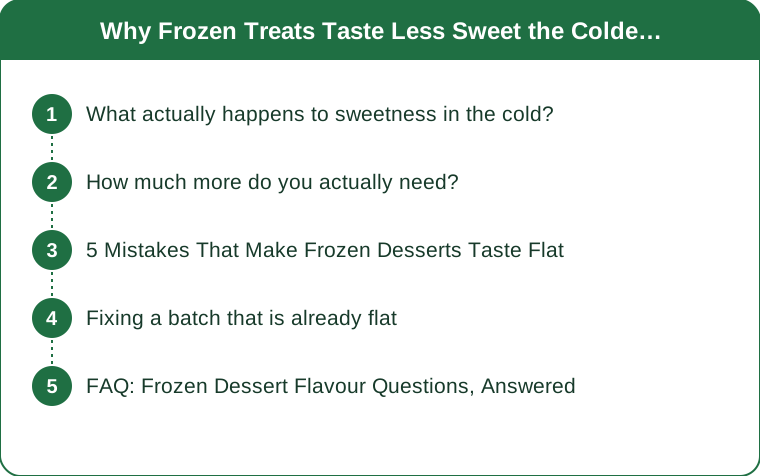
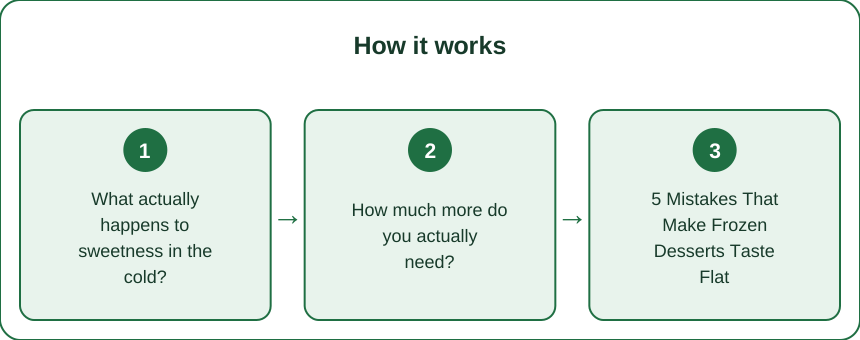
What actually happens to sweetness in the cold?
Two mechanisms, and both point the same direction.
Sweet taste receptors are temperature sensitive. The receptor proteins on the tongue that detect sweetness respond differently at different temperatures, and their responsiveness is reduced at cold temperatures. This is a well-documented effect - the same sucrose solution genuinely tastes less sweet when chilled, and the difference is large enough to be obvious in a side-by-side test.
The effect is not uniform across tastes. Sweetness is strongly affected by cold. Saltiness is also reduced but somewhat less so. Bitterness and sourness are comparatively less affected, which means cold shifts the whole balance of a preparation, not just its sweetness level.
This is why cold food tends to need more seasoning generally - and why the flat, slightly bitter quality of an under-sweetened frozen dessert is a specific and recognisable failure rather than just a mild one.
Aroma is the bigger loss. Most of what people describe as flavour is actually retronasal aroma - volatile compounds travelling from the mouth up to the olfactory receptors. Volatility falls sharply with temperature, so a frozen dessert releases dramatically fewer aroma compounds than the same mixture at room temperature.
Which means the vanilla, the fruit, and the chocolate all fade together with the sweetness. The frozen version is not just less sweet - it is quieter across the whole flavour profile, and that combined effect is what makes people think something went wrong during churning.
How much more do you actually need?
Enough that the base tastes noticeably over-sweetened and over-flavoured at room temperature.
The practical rule: taste the base at room temperature and aim for something you would describe as slightly too sweet - not unpleasantly so, but a step beyond where you would stop if you were serving it warm. That is roughly the right target.
Sugar is not only a sweetener here, which constrains how much you can adjust. Sugar lowers the freezing point of the mixture, which is what keeps ice cream scoopable rather than solid. Reduce it too far and you get a rock; increase it too far and you get something that never sets firmly. This is why you cannot simply solve blandness by adding sugar indefinitely - the texture is on the other end of the same lever.
Typical ranges: most ice cream recipes sit somewhere around 14 to 18 per cent sugar by weight of the total mix, and sorbets are usually higher because they have no fat to carry flavour. Working within that range and adjusting the flavouring is usually more productive than pushing the sugar.
Salt is the underused adjustment. A small pinch of salt in a sweet frozen base enhances perceived sweetness and improves flavour perception generally, without affecting the freezing point meaningfully. Most home recipes under-use it substantially.
And acidity does something similar. A small amount of lemon juice in a fruit sorbet, or a little in a dairy base, brightens the whole thing and makes the flavour read as more present. Sourness is less suppressed by cold than sweetness, so it survives the temperature drop better and pulls the rest along with it.

5 Mistakes That Make Frozen Desserts Taste Flat
1. Tasting the base cold and adjusting from there. If you chill the base, taste it, and find it correct, it will still lose more as it freezes and hardens. Adjust at room temperature aiming for slightly too much, or chill it and aim for clearly too much. Either works; tasting cold and aiming for correct does not.
2. Under-flavouring on the assumption that concentration happens. It does not. Nothing about churning intensifies flavour - freezing dilutes the perception of everything. A vanilla base needs more vanilla than a warm custard does, not less. Double what a warm preparation would call for is often about right for aroma-driven flavours.
3. Skipping salt. A quarter teaspoon in a standard batch changes perceived sweetness and flavour intensity noticeably, and almost nobody adds it to a sweet base. It is the cheapest improvement available.
4. Serving straight from a domestic freezer. Home freezers run at around -18C, which is considerably colder than ice cream is meant to be eaten. Serving temperature for ice cream is closer to -12C. Ten to fifteen minutes on the counter before serving genuinely restores a substantial amount of both sweetness and aroma - this single habit fixes more perceived flavour problems than any recipe change.
5. Using low-fat dairy without compensating. Fat carries aroma compounds and delivers them during eating. A lower-fat base loses flavour on top of the temperature losses, and needs more flavouring, more sugar, or a stabiliser to compensate for the texture as well.
Fixing a batch that is already flat
You cannot un-freeze the problem entirely, but there are three genuinely effective options.
1. Serve it warmer. Ten to fifteen minutes out of the freezer before serving is the single highest-return intervention, and it requires changing nothing about the recipe. The difference between -18C and -12C is dramatic in perceived sweetness and aroma.
2. Add a contrasting element at serving. A sauce at room temperature, a sprinkle of flaky salt, a squeeze of citrus, or something crunchy and strongly flavoured. Warm sauce over cold ice cream is a classic pairing precisely because the warm component releases aroma that the frozen one cannot.
3. Re-churn with additions. If the batch is genuinely under-flavoured, let it soften to a thick paste, blend in more flavouring - and a little more sugar if the texture will take it - and re-freeze. Texture suffers somewhat from re-churning, but a flavourful slightly-icy dessert beats a smooth bland one.
For next time, the checklist:
- Taste at room temperature, aim for slightly too sweet and clearly too flavoured.
- Add a pinch of salt - about a quarter teaspoon per litre of base.
- Add a small amount of acid for fruit-based preparations.
- Use full fat where the recipe expects it.
- For sorbets especially, go stronger on flavour than feels right; there is no fat carrying it.
- Age dairy bases in the fridge for four hours or overnight before churning - it improves both texture and flavour perception.
And one note on late-summer fruit: this is the best fruit of the year for frozen desserts, and ripe late-season peaches, berries, and plums have enough concentrated flavour to survive the temperature suppression better than earlier fruit does. Worth making a batch now rather than in January.
FAQ: Frozen Dessert Flavour Questions, Answered
Why does ice cream taste less sweet than the base?
Because sweet taste receptors are less responsive at cold temperatures, so the same sugar concentration registers as considerably less sweet when frozen. Cold also suppresses aroma volatility, and most of what we perceive as flavour is aroma - so the whole profile fades together.
How sweet should an ice cream base taste before churning?
Slightly too sweet at room temperature - a step beyond where you would stop if serving it warm. If it tastes exactly right warm, it will taste flat once frozen. The same applies to flavouring, which should read as noticeably strong before churning.
Why does letting ice cream sit before serving improve it?
Home freezers run around -18C, well below the ideal serving temperature of about -12C. Ten to fifteen minutes on the counter raises the temperature into the range where sweet receptors and aroma release both work much better - it is the single most effective fix available.
Does adding salt to ice cream help?
Yes. A small amount - roughly a quarter teaspoon per litre of base - enhances perceived sweetness and overall flavour without meaningfully affecting the freezing point. It is one of the most under-used adjustments in home frozen desserts.
TL;DR:
- Cold reduces sweet receptor responsiveness and suppresses aroma volatility at the same time.
- Aim for a base that tastes slightly too sweet and clearly too flavoured at room temperature.
- Sugar also controls texture, so flavouring and salt are the safer levers to push.
- Ten to fifteen minutes on the counter before serving fixes more than any recipe change.
- Full fat carries aroma; a pinch of salt and a little acid do more than you would expect.
The custard was not lying to you. It was just being tasted under much better conditions than the ice cream ever gets.
Keep Reading
This article is for general informational purposes only and is not medical advice. Always consult a qualified health professional for guidance specific to you.