Why Frozen Desserts Taste Less Sweet Than the Mix Did
Quick Answer: Cold suppresses perceived sweetness. Your sweet taste receptors are temperature-sensitive and respond most strongly around body temperature, so the same sugar concentration tastes noticeably less sweet at -12°C than at room temperature. Aroma release also drops sharply when cold. The practical rule: taste your base slightly over-sweet and slightly over-flavored, roughly 10 to 20% stronger than you want the finished result to be.
Every home ice cream maker runs into this once. The custard is perfect off the spoon, and four hours later it is a beautifully textured, oddly flat dessert.

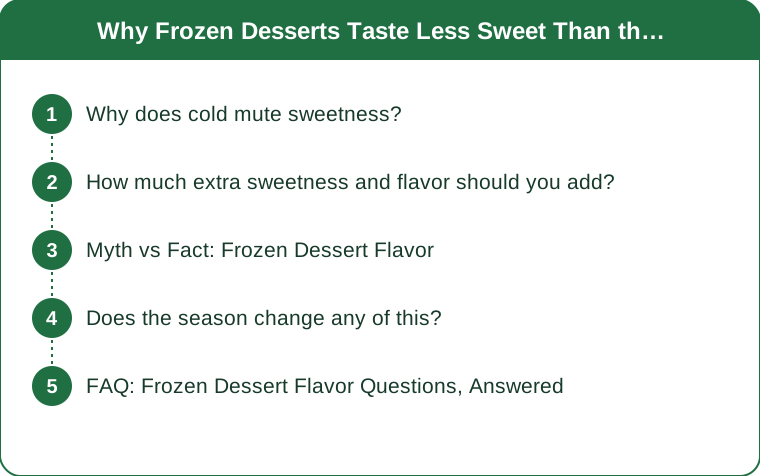
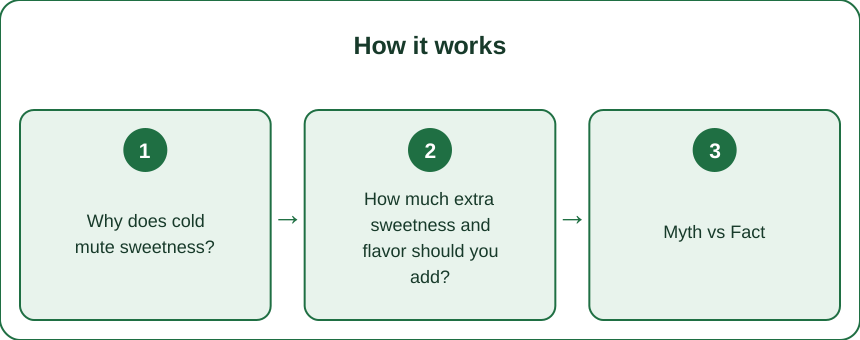
Why does cold mute sweetness?
Because the receptors that detect sweetness work better warm - this is a property of the biology, not of the sugar.
Sweet receptors are temperature-dependent. The channel involved in sweet detection responds more strongly as temperature rises toward body temperature. Warm the same solution and it tastes sweeter; chill it and it tastes weaker, with no change in composition.
Aroma is the bigger loss. Most of what we call flavor is retronasal smell. Volatile aroma compounds evaporate far less at freezing temperatures, so a frozen dessert delivers a fraction of the aroma the same base delivers at room temperature. Vanilla, fruit esters, and coffee notes all take a heavy hit.
Fat coats the tongue and slows release. In a rich ice cream, the fat that gives you good texture also delays flavor release. This is a fair trade, but it means high-fat bases need more flavoring than sorbets do.
Air changes the perception too. Churned product contains incorporated air, which dilutes flavor per spoonful relative to the unchurned base you tasted.
Which is why the melted version always tastes right. If your finished ice cream tastes correct once it melts on the spoon, the recipe is fine - the delivery temperature is what changed.
How much extra sweetness and flavor should you add?
Enough that the base tastes slightly too strong at room temperature, which is a specific and testable target.
Aim for 10 to 20% over your target. Taste the base at room temperature. It should read as a touch sweeter and a touch more intensely flavored than you want the frozen result to be - not dramatically so.
Better still, taste it cold. Chill a spoonful in the freezer for a few minutes and taste that. It is a far more accurate preview than tasting the warm base and guessing.
But sugar is not only a flavor. In frozen desserts, sugar controls freezing point and therefore texture. Adding a lot more sugar softens the result, and taking it out makes it icy and hard. You cannot adjust sweetness freely without changing texture - which is the real constraint.
Use salt to do part of the job. A small pinch of salt increases perceived sweetness and intensity without altering the freezing point meaningfully. This is the single most underused adjustment in home frozen desserts.
And push aroma harder than sweetness. Since aroma loss is the larger effect, increasing vanilla, zest, coffee, or fruit concentration usually improves the result more than adding sugar - and it does not compromise texture.

Myth vs Fact: Frozen Dessert Flavor
Myth: Commercial ice cream is just much sweeter. Fact: It is often sweeter, but the larger difference is stabilizers and controlled aeration that alter melt behavior and flavor release on the tongue. Sweetness alone does not explain the gap.
Myth: Adding more sugar always makes it taste better. Fact: Past a point, more sugar makes the product soft, slushy, and slow to set, and it can taste cloying once melted. Texture and sweetness are coupled, and pushing one moves the other.
Myth: You should serve it straight from the freezer. Fact: Most home ice cream tastes considerably better after 10 to 15 minutes of tempering in the fridge or on the counter. Warming from -18°C to around -12°C restores a large share of the perceived flavor.
Myth: Fruit sorbets do not need this adjustment. Fact: They need it most. Sorbets have no fat to carry flavor and rely entirely on the fruit, so the cold suppression is more noticeable. Fruit picked at peak ripeness in late summer helps more than any technique.
Myth: If it tastes bland, the recipe failed. Fact: Let a spoonful melt fully and taste again. If the melted version tastes right, your recipe is correct and your serving temperature is what needs adjusting.
Does the season change any of this?
Yes, in two directions worth knowing about in late summer.
Peak-season fruit needs less help. Late August stone fruit and berries are at their highest sugar and aroma concentration of the year. The same recipe made in February with imported fruit will taste noticeably flatter and needs more sugar and acid to compensate.
Acid is the seasonal lever. A squeeze of lemon in a fruit base sharpens perceived flavor without adding sweetness and without touching the freezing point. It is the fastest fix for a sorbet that tastes muted.
Warm kitchens change churning. A hot kitchen in August means your base warms while it churns, producing larger ice crystals and a coarser texture that also dulls flavor perception. Chill the base thoroughly - ideally overnight - and freeze the bowl longer than you think you need.
Freezer traffic matters more in summer. A freezer opened frequently on hot days runs through temperature swings that cause recrystallization, which is the cause of that gritty, flavor-flat texture in a batch that was fine two days ago. Store at the back, in a shallow container, with a layer of parchment on the surface.
And serve at the right temperature deliberately. Set a timer for 12 minutes on the counter rather than eyeballing it. It is the highest-value habit in home frozen desserts and it costs nothing.
FAQ: Frozen Dessert Flavor Questions, Answered
How much sweeter should the base taste before freezing?
Noticeably but not unpleasantly - roughly 10 to 20% above your target. The more reliable method is to freeze a test spoonful for a few minutes and taste that directly.
Why does my ice cream taste better on the second day?
Usually because it has fully hardened and you are tempering it before serving, and because some flavors - vanilla, spices, chocolate - continue to develop in the base. Ripening the base in the fridge overnight before churning has a similar effect.
Does salt really make it taste sweeter?
A small amount does enhance perceived sweetness and rounds out flavor, particularly in caramel, chocolate, and dairy bases. Start with a pinch per liter and adjust - it is easy to overdo.
What temperature should ice cream be served at?
Around -12°C is where most ice cream shows its best texture and flavor, versus the -18°C of a typical home freezer. That difference is roughly 10 to 15 minutes out of the freezer.
TL;DR:
- Cold suppresses sweet receptors and aroma release, so a perfect base tastes flat once frozen.
- Aim for a base that is 10 to 20% stronger than the target, and taste a frozen test spoonful rather than the warm base.
- Sugar controls texture as well as sweetness - use salt and acid to boost perception without softening the result.
- Temper for 10 to 15 minutes before serving; it recovers more flavor than any recipe change.
The most useful habit here is the frozen test spoon, because it converts guesswork into measurement and takes four minutes. The second most useful is the timer on the counter - a huge share of disappointing homemade ice cream is not a recipe failure at all, just a dessert served fifteen degrees too cold to taste.
Keep Reading
This article is for general informational purposes only and is not medical advice. Always consult a qualified health professional for guidance specific to you.