Frozen Treats Do Not Have to End With Summer
Quick Answer: Cold desserts feel less appealing as the weather cools because thermoregulation changes what your body wants, not because they stop tasting good. Warmer flavor profiles — spice, caramelized fruit, nut butters, cocoa — and smaller portions served with something warm bridge the gap. Autumn also improves homemade frozen treats: cooler kitchens mean less melting during preparation and better texture.
There is a specific week in October when the frozen yogurt in the freezer stops getting eaten and starts getting freezer burn.
The craving did not disappear because the food got worse. It changed shape, and the food can change with it.

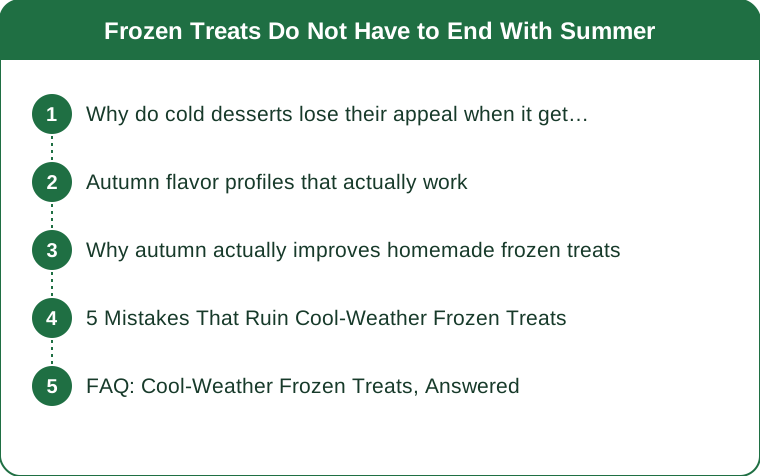
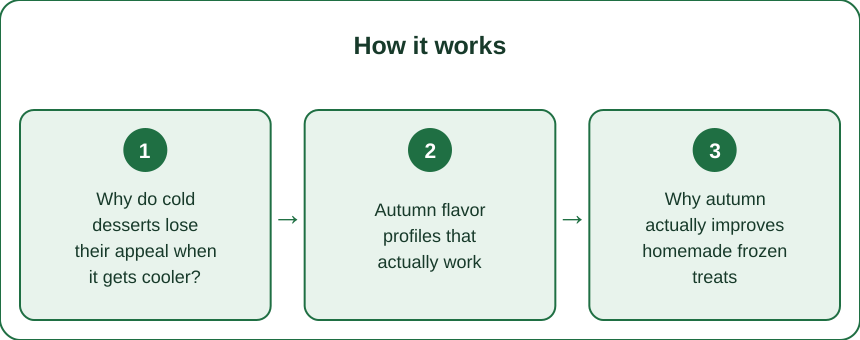
Why do cold desserts lose their appeal when it gets cooler?
Mostly thermoregulation, with a large helping of association.
Your body genuinely wants cold things less when it is cooler. Eating cold food requires warming it, which costs energy, and in a warm environment that cooling effect is welcome. In a cool environment it is not. This is a real preference shift, not just habit — the same ice cream is less pleasant at an ambient 60°F than at 85°F.
Flavor perception also changes with temperature. Cold suppresses volatile aroma compounds, which is why very cold food tastes less intensely flavored. In summer, that muting is fine because the coldness itself is the point. In cooler weather, the muted flavor becomes the dominant impression and the treat tastes bland rather than refreshing.
And association is powerful. Frozen treats are so strongly linked to hot weather that autumn context alone reduces the appeal.
What this tells you about the fix: increase the flavor intensity and the warmth of the flavor profile, and reduce the portion so the cooling load is smaller. A small serving of intensely flavored frozen yogurt with warm spiced fruit is a completely different experience from a large bowl of vanilla.
The other half of the fix is temperature contrast. Cold with something warm alongside — warm fruit compote, a warm drink, a warm baked element — reads as comforting rather than as a summer food out of season.
Autumn flavor profiles that actually work
Spiced and warm-toned: cinnamon, ginger, cardamom, nutmeg, and clove all read as autumn and all survive freezing well. Spices are volatile-aroma-heavy, which is exactly what cold food needs — they punch through the flavor muting that low temperatures cause.
A frozen yogurt base with a full teaspoon of cinnamon and a pinch of cardamom tastes dramatically more present than the same base plain.
Caramelized and roasted fruit: roasting apples, pears, or plums before folding them in concentrates their sugars and deepens the flavor. Roasted fruit in a frozen treat is one of the most underrated autumn techniques and it costs twenty minutes of oven time.
Nut butters and tahini: fat carries flavor and improves frozen texture at the same time. A swirl of almond butter or tahini through a frozen yogurt base makes it both taste richer and scoop softer.
Cocoa and coffee: both are intensely flavored enough to survive freezing and both read as cool-weather flavors.
Squash and sweet potato: roasted and puréed, they make a naturally creamy frozen base with genuine autumn character. This sounds strange and works remarkably well — the starch content improves texture in the same way banana does.
What to move away from: bright citrus and light berry profiles that were perfect in July. They are not bad, they simply read as out of season, and seasonality is a large part of why a food is satisfying.

Why autumn actually improves homemade frozen treats
Three technical advantages that nobody mentions.
1. Your kitchen is cooler, so the mixture stays colder during preparation. The enemy of good homemade frozen texture is partial melting and refreezing, which creates large ice crystals. A cooler kitchen means less melting between the machine and the freezer, which means smaller crystals and a smoother result.
This is a bigger effect than it sounds. The same recipe made in a 75°F kitchen and a 65°F kitchen produces noticeably different texture.
2. Your freezer works better. A freezer in a hot kitchen in August is fighting ambient heat and cycling constantly, which produces temperature fluctuations. Fluctuating freezer temperature is the main cause of the icy layer that forms on stored frozen desserts. In autumn the freezer holds a steadier temperature and things store better.
3. The best fruit for freezing is available. Late apples, pears, plums, and the last of the stone fruit all freeze and cook well. Roasting them first is the single highest-value step for any homemade frozen dessert.
A texture note that applies year-round but matters more now: homemade frozen treats are harder than commercial ones because they lack the stabilizers and the churned-in air. Let anything homemade sit at room temperature for 5 to 10 minutes before serving. In a cool kitchen this takes longer than it did in summer, which is why homemade frozen desserts feel unpleasantly hard in autumn specifically.
5 Mistakes That Ruin Cool-Weather Frozen Treats
1. Serving the same portion size as summer. A large cold portion in cool weather is a thermoregulatory burden and it stops being enjoyable halfway through. Half the summer portion, twice the flavor intensity is the correct adjustment.
2. Under-flavoring the base. Cold mutes flavor. A base that tastes correctly sweet and flavored at room temperature will taste flat once frozen. Taste the base before freezing and make it slightly too strong.
3. Skipping the fat. Low-fat frozen desserts freeze harder and taste blander, and both problems get worse in a cold kitchen. A little full-fat yogurt, nut butter, or coconut milk transforms both texture and flavor.
4. Storing it in a wide shallow container. More surface area means more freezer burn and more ice crystal formation over time. A deep container with a piece of parchment pressed onto the surface is the standard fix and it works well.
5. Letting the freezer become a graveyard. The most common autumn outcome is not bad frozen treats — it is frozen treats that sit untouched for two months and get thrown out. Make smaller batches. A batch that lasts four days is better than one that lasts six weeks, and the fourth-day version tastes far better than the six-week one.
FAQ: Cool-Weather Frozen Treats, Answered
Is there any nutritional reason to stop eating frozen treats in autumn?
No. Nothing about cooler weather changes what a frozen yogurt or a fruit-based dessert contributes. The change is preference and comfort, not nutrition.
What is the easiest autumn upgrade to an existing recipe?
Roast the fruit first. Twenty minutes at 400°F transforms apples, pears, or plums and it improves both flavor depth and texture in the final product.
Does warm topping on a frozen base actually work or does it just melt it?
It works if the topping is warm rather than hot and the base is properly frozen. Warm spiced fruit over a firmly frozen yogurt is a classic contrast; hot sauce over soft-frozen yogurt is a puddle.
Why does my frozen yogurt get icy after two weeks in autumn?
Usually freezer door opening rather than the recipe. Each opening lets warm air in and the surface partially melts and refreezes. Store it at the back, not in the door.
TL;DR: The craving changed shape rather than disappearing.
- Cold food genuinely appeals less in cool weather because warming it costs energy — and cold mutes flavor, making it taste blander at the same time.
- Increase flavor intensity, decrease portion size. Half the summer serving with twice the spice.
- Autumn flavor profiles work: cinnamon and cardamom, roasted fruit, nut butters, cocoa, and roasted squash.
- Pair cold with warm — warm spiced fruit over frozen yogurt reads as comforting rather than out of season.
- Cooler kitchens make better texture. Less melting during preparation means smaller ice crystals.
- Make smaller batches. The autumn failure mode is a container that sits for two months.
Roast a pan of apples with cinnamon this weekend and spoon them warm over whatever is in your freezer. That is the whole transition.
Keep Reading
This article is for general informational purposes only and is not medical advice. Always consult a qualified health professional for guidance specific to you.